What is a Multiplexing? A Clear Guide for Beginners
Optical multiplexing, particularly Dense Wavelength Division Multiplexing (DWDM), is gaining traction in fibre-optic networks, allowing for even greater bandwidth utilisation by transmitting
Here, we develop a novel design approach that co-optimizes inverse-designed wavelength division multiplexers and distributed Bragg gratings to achieve ultra-low crosstalk without compromising insertion loss. Wavelength division multiplexing (WDM) is a technology for increasing the transmission capacity of optical fiber communications by sending multiple data channels simultaneously through a single fiber, each on a different wavelength of light. To begin with, we assume that we have the element parameters from a known process design kit (PDK).
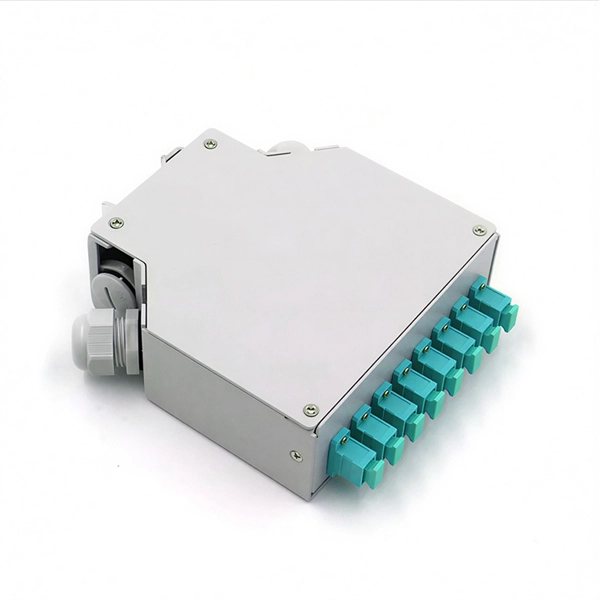
Optical multiplexing, particularly Dense Wavelength Division Multiplexing (DWDM), is gaining traction in fibre-optic networks, allowing for even greater bandwidth utilisation by transmitting
1. What is Wavelength Division Multiplexing (WDM)? Wavelength Division Multiplexing (WDM) is a technique that combines multiple optical signals
OverviewSystemsCoarse WDMDense WDMEnhanced WDMShortwave WDMTransceivers versus transpondersSee also
A WDM system uses a multiplexer at the transmitter to join the several signals together and a demultiplexer at the receiver to split them apart. With the right type of fiber, it is possible to have a device that does both simultaneously and can function as an optical add-drop multiplexer. The optical filtering devices used have conventionally been etalons (stable solid-state single-frequency Fabry–Pérot interferometers in the form of
The advent of coherent optical links and advanced multiplexing techniques used in wireless communication raised the achievable bandwidth limit
At MEETOPTICS, you can find and compare Wavelength Division Multiplexers (WDMs) for combining or splitting light at two different wavelengths. MEETOPTICS offers a variety of multiplexers with
Multiplexing in networking combines multiple signals into one channel, enabling efficient data transmission and better use of network resources.
Wavelength Division Multiplexing (WDM) Wavelength Division Multiplexing (WDM) is a technology used in optical fiber communication systems
Here, we develop a novel design approach that co-optimizes inverse-designed wavelength division multiplexers and distributed Bragg gratings to achieve ultra-low crosstalk without compromising
Wavelength-division multiplexing (WDM) is defined as a technology that multiplexes multiple optical carrier signals onto an optical fiber by using different wavelengths of laser light, enabling bidirectional
This section contains examples of wavelength division multiplexing (WDM) circuits. Wavelength division multiplexing is a method of modulating multiple signals at
Wavelength Division Multiplexing (WDM) is defined as an approach that multiplexes multiple wavelength channels from different end-users into a single fiber, facilitating the transmission of various services
Wavelength division multiplexing (WDM) is a technology for increasing the transmission capacity of optical fiber communications by sending multiple data
Wavelength division multiplexing (WDM) is a technique of multiplexing multiple optical carrier signals through a single optical fiber channel by varying the
This paper discusses in detail the wavelength division multiplexing (WDM) technology, which effectively increases the communication capacity and transmission speed by simultaneously transmitting
Wavelength division multiplexing or WDM allows the combining of a number of independent information-carrying wavelengths onto the same fiber, because of the wide spectral
BiDi technology challenges this conventional architecture by using Wavelength Division Multiplexing (WDM) principles to achieve bidirectional
Discover the comprehensive guide to Wavelength Division Multiplexing, its role in optical properties, and its significance in modern telecommunications.
Interoperability is critical to achieving the fluid information flow that unlocks the potential of operational and information systems in various industries.
Time Division Multiplexing (TDM) enables multiple data streams over a single channel by dividing bandwidth into time slots, optimizing connectivity and resource use.
WDM (Wavelength Division Multiplexing) technology is an ideal solution to get more bandwidth and lower cost in nowaday telecommunications
WDM, or Wavelength Division Multiplexing, is another such multiplexing technique. It shares similarities with FDM (Frequency Division Multiplexing) due to their mathematical relationship: Wavelength = C
The article explains the fundamental principle and its advantages over using a single high-bandwidth channel, particularly in overcoming limitations from electronic speeds and optical dispersion.
Co-Packaged Optics (CPO) has long promised to transform datacenter connectivity, but it has taken a long time for the technology to come to market,
Code Division Multiplexing (CDM): CDM assigns a unique code to each input signal and spreads the signals across a wide frequency band. The signals can be separated at the receiving
Our photonic engineering team can help you select the right connector or splitter for your network.